Command decisions under pressure dominate this week — Nagumo's rearming agony in Harris's superb Midway episode, Nivelle's hubris in the French Army series, Watson dismantling "lions led by donkeys" on the same feed. Two Essentials from Battles of the First World War in one week is a rare treat.
🎯 This Week's Pick
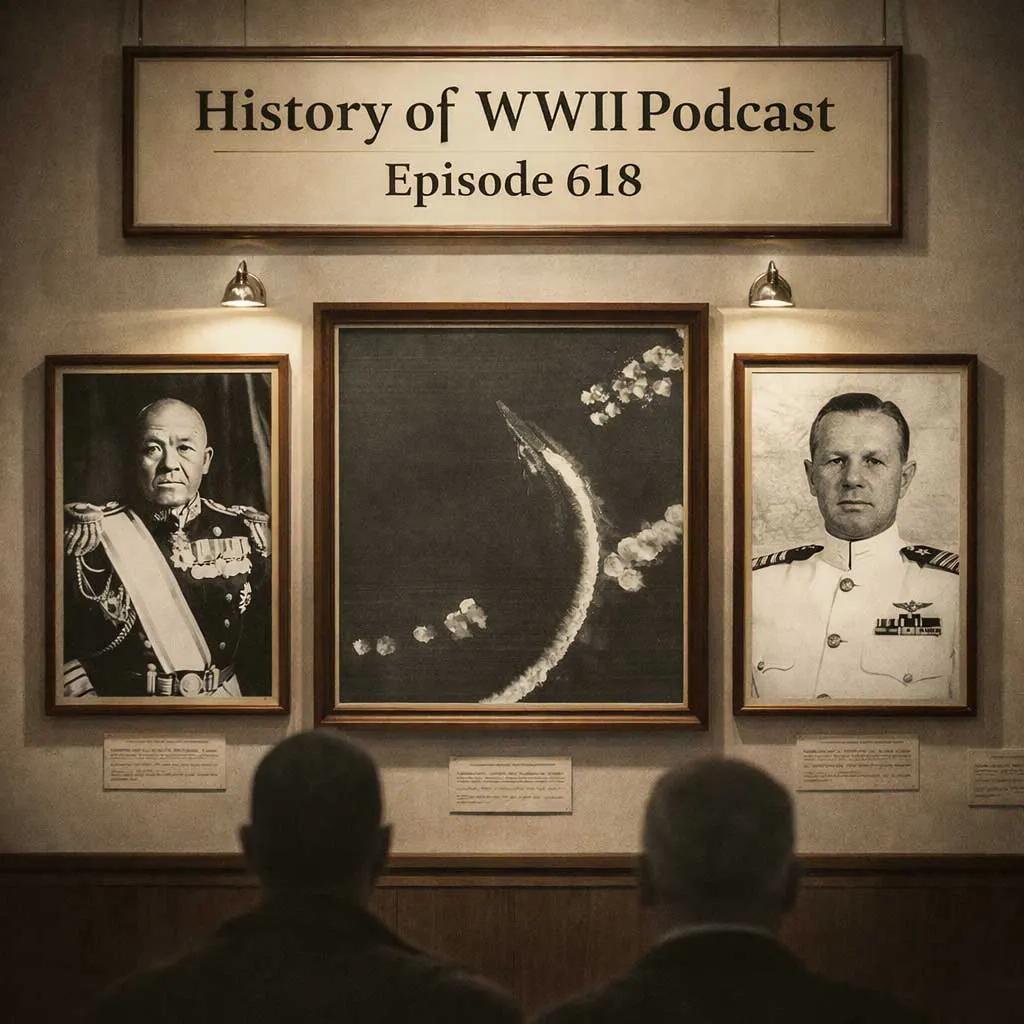
Episode 618-Midway: Nagumo's Dilemma
The History of WWII Podcast · 28:41 · Apr 15
Ray Harris Jr. — independent historian covering WWII chronologically
World War IINavalLeadership & Command
Ray Harris Jr. gets to one of the most agonised-over command decisions of the Pacific War: Nagumo's fifteen-minute window after the first Midway strike, with land-based aircraft and carrier planes pressing attacks simultaneously. This is the rearming controversy in real time — Harris walks through the tactical problem methodically, showing a commander buckling under compounding pressure as continuous American attacks progressively stripped him of his options. At under 30 minutes it's compact, but this is the hinge moment of Midway done properly.
🔴 Essential
The French Army in the First World War, a Discussion: Pt 7, Pt 1
Battles of the First World War · 1h24m · Apr 16
World War ILeadership & CommandStrategy & Grand Strategy
This long-running series reaches the French Army in 1917 — Nivelle's rise, the offensive that destroyed his career, and the crucial question of whether what followed were mutinies or something more nuanced. At nearly 90 minutes, there's proper space to examine the gulf between the army's tactical competence and a senior leadership whose hubris under political and operational pressure proved catastrophic. The discussion of French indiscipline is handled with real care, distinguishing between the popular myth and what the evidence actually shows. Excellent stuff for anyone interested in the Western Front beyond the BEF.
British Doctrine in the Great War with Phil Watson
Battles of the First World War · 1h42m · Apr 12
Phil Watson — British Army veteran and PhD candidate, University of Wolverhampton
World War ITactics & BattlesLeadership & Command
Phil Watson — a British Army veteran and PhD candidate researching BEF doctrine — joins for nearly two hours on one of the most misunderstood aspects of the Great War: whether the British Army had a coherent doctrine, how it evolved under the pressure of industrial warfare, and why the 'lions led by donkeys' narrative misses what was actually happening with decentralised command and initiative. The questions Watson poses to listeners — why chateaus, and whether BEF officers were conditioned against initiative — are exactly the right ones. Superb companion piece to the French Army episode from the same feed this week.
Episode 409 - The Anglo-Satsuma War
Lions Led By Donkeys · 1h37m · Apr 13
Peter Crean & Luke Robinson
19th CenturyNavalColonial & Imperial
Lions Led By Donkeys tackles the 1863 bombardment of Kagoshima — the bizarre little naval war between the Royal Navy and the Satsuma domain that grew out of the Namamugi Incident. At nearly 100 minutes, there's room for the political context of Bakumatsu Japan and the operational details of the bombardment itself. An excellent example of the show's strength: a conflict most listeners won't know, told with energy and an eye for the absurd command decisions on both sides.
302 - Task Force Hogan
The WW2 Podcast · 40:16 · Apr 15
Angus Wallace & William Hogan — son of Lt. Col. Sam Hogan
World War IITactics & BattlesLeadership & Command
Angus Wallace interviews William Hogan about his father Sam Hogan, who commanded a Sherman tank battalion from the Normandy bocage through the Bulge and into Germany — one of the youngest lieutenant colonels in the US Army at 28. The episode covers the hedgerow fighting, the desperate encirclement during the Ardennes, and what it meant to lead armour at the sharp end of ETO. Good personal angle grounded in operational specifics.
🟡 Selections
Season 5 Finale--Questions and Answers on the Pacific War
Unauthorized History of the Pacific War · 2h14m · Apr 14
Seth Paridon — former chief historian, National WWII Museum & Jon Parshall — author of Shattered Sword
World War IINaval
Seth Paridon and Jon Parshall wrap up Season 5 with a two-hour-plus Q&A covering a wide range of Pacific War topics — Midway, Saipan, carrier operations, and more. The format means it's scattershot rather than focused, but two hours with Parshall is never wasted time.
Belfast, Bunkers, and Vichy Show Trials
We Have Ways of Making You Talk · 42:29 · Apr 13
Holland & Murray
World War IIFortification & Siege
Holland and Murray do their on-this-day format for April 14th across the war years — German coastal defence strategy in Norway, the engineering of HMS Belfast, and the collapse of Vichy's show trials. The Norwegian fortification discussion is the standout segment, and the Vichy material is entertaining on the farcical politics of collaboration.
661. Dawn of the Samurai: The Shōgun Triumphant (Part 4)
The Rest Is History · 1h04m · Apr 15
Holland & Sandbrook
MedievalTactics & Battles
Holland and Sandbrook conclude their samurai series with the climax of the Genpei War — the final Minamoto-Taira clashes and how the samurai class came to dominate Japan. Over an hour and genuinely engaged with the military dimension, including female warriors and decisive battles.
The Hittites
The Ancients · 58:36 · Apr 16
Dr Tristan Hughes & Prof. Elena Devecchi
Ancient
Tristan Hughes and Professor Elena Devecchi survey the Hittite empire — diplomacy, religion, royal intrigue, and the sack of Babylon. Military campaigns feature but share space with festivals, theology, and archives.
📚 Reading List
Task Force Hogan: The World War II Tank Battalion That Spearheaded the Liberation of Europe — William Hogan
William Hogan tells the story of his father Sam, one of the youngest lieutenant colonels in the US Army, who commanded a Sherman tank battalion from Normandy through the Bulge and into Germany. A son's account built from personal knowledge and research — the kind of unit-level narrative that puts you in the turret.
Via: 302 - Task Force Hogan, The WW2 Podcast
📖 Amazon UKShattered Sword: The Untold Story of the Battle of Midway — Jonathan Parshall and Anthony Tully
Jon Parshall — co-host of the Unauthorized History of the Pacific War — co-wrote this Japanese-perspective account of Midway that dismantles decades of received wisdom about Nagumo's decisions. Pairs perfectly with the WWII Podcast's deep dive into Nagumo's dilemma on the morning of 4 June 1942.
Via: Episode 618 - Midway: Nagumo's Dilemma, The History of WWII Podcast / Season 5 Finale, Unauthorized History of the Pacific War
📖 Amazon UKThe Namamugi Incident: And the Anglo-Satsuma War — William de Lange
The Lions Led By Donkeys episode on the Anglo-Satsuma War lists this as a source — it covers the 1862 killing of Charles Richardson by Satsuma samurai and the punitive bombardment of Kagoshima that followed. A tightly focused account of one of the stranger collisions between Western imperialism and late-Tokugawa Japan.
Via: Episode 409 - The Anglo-Satsuma War, Lions Led By Donkeys
📖 Amazon UKDare Call It Treason: The True Story of the French Army Mutinies of 1917 — Richard M. Watt
The Battles of the First World War discussion on the French Army in 1917 wrestles with whether the indiscipline was mutiny or military labour strikes — Watt's classic account of Nivelle's catastrophic offensive and its aftermath is the natural companion read for that exact question.
Via: The French Army in the First World War, Pt 7 Pt 1, Battles of the First World War
📖 Amazon UK
If a friend would find this useful, send them the link. That’s the entire growth strategy.