Operational grit dominates this week, and the Pick — Tommo Thomas directing naval gunfire across the Falklands on The Unconventional Soldier — earns it with forward-observer detail you almost never hear. Parshall on Bataan and Holland wrapping the Oudna series both demand your time; DeVries on Formigny rounds out a stacked queue.
🎯 This Week's Pick
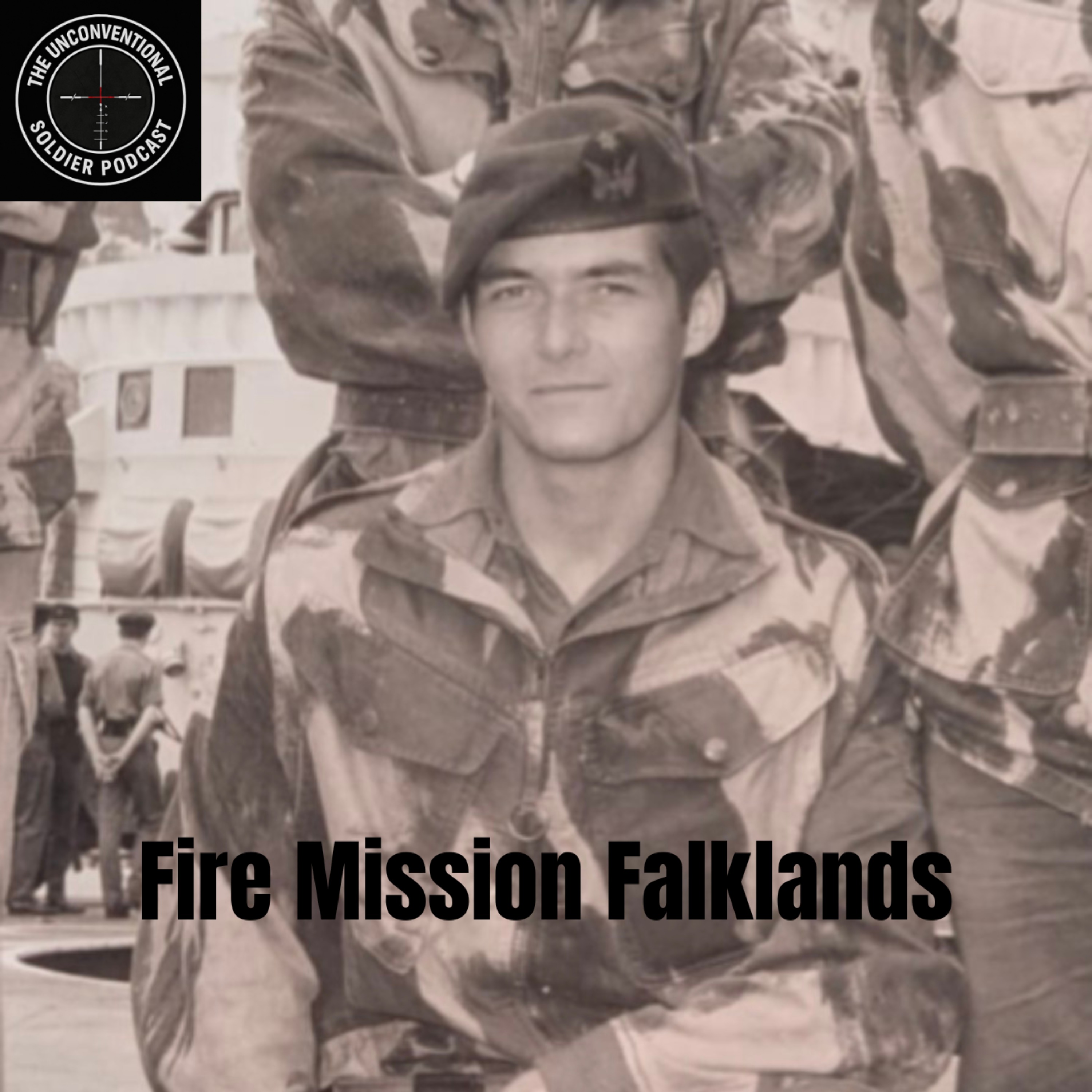
Fire Mission Falklands: A 148 Battery Commando's War
The Unconventional Soldier · 1h31m · Jul 15
Steve "Tommo" Thomas — 148 Commando Forward Observation Battery veteran; hosted by Colin Ferguson — British Army veteran (22 years' service)
Cold WarTactics & BattlesMemoir & Personal Account
Steve "Tommo" Thomas recounts his service with 148 Commando Forward Observation Battery during the Falklands, directing naval gunfire and artillery in some of the campaign's worst conditions. Thomas's unusual path — Royal Navy sailor turned commando and P Company graduate — gives him a perspective few veterans can match, and the detail on forward observation work in the South Atlantic is the kind of operational granularity you rarely get, a ground-level account of the grit required to call fire accurately while exposed, freezing, and under contact. Colin Ferguson, himself a 22-year Army veteran, knows exactly what questions to ask, and the 90-minute runtime lets the conversation breathe.
🔴 Essential
The First Attacks on the Bataan Peninsula: January 1942
Unauthorized History of the Pacific War · 1h37m · Jul 14
Seth Paridon — former chief historian, National WWII Museum; Jon Parshall — co-author of Shattered Sword
World War IITactics & BattlesLeadership & Command
Paridon and Jon Parshall dig into the Japanese attacks on the Abucay Line in January 1942, where General Parker's II Corps — outgunned, undersupplied, and running on sheer operational tenacity — fought Homma's forces to a standstill. The episode is excellent on Homma's overconfidence and the sharp tactical engagements that proved the Fil-American defenders were far more capable than Japanese intelligence had assessed. At 97 minutes with Parshall contributing, this is the Pacific War podcast at its best — granular, well-sourced, and focused on a campaign phase that most treatments of the Philippines rush past.
The Battle of Formigny
Bow & Blade · 1h16m · Jul 17
Kelly DeVries — Emeritus Professor, Loyola; Honorary Historical Consultant, Royal Armouries; Michael Livingston — Professor, The Citadel
MedievalTactics & Battles
Kelly DeVries and Michael Livingston break down the Battle of Formigny, the 1450 engagement that effectively ended English control of Normandy and brought the Hundred Years' War to its close. The episode traces the campaign leading up to the battle — the French reconquest of Normandy, the English defensive posture, and the tactical details of the fight itself, where French artillery and a flanking force destroyed an English army that had initially held its ground. DeVries and Livingston bring genuine academic weight to a battle that rarely gets this level of attention.
🌍 The Other Side: France's view of Formigny as artillery revolution
English-language scholarship typically frames Formigny as a flanking action — the Breton force under Richemont arriving on the English flank decided the battle after a conventional infantry engagement. French military historiography, particularly work by Philippe Contamine (medieval military historian, Université Paris-Sorbonne), places far greater emphasis on Jean Bureau's culverins as the decisive innovation. In this reading, Bureau's field artillery forced the English out of their prepared defensive position before Richemont arrived, marking Formigny as a turning point where gunpowder systematically negated the English longbow-and-stakes defensive system that had dominated since Crécy. The battle becomes less an accident of timing and more evidence of deliberate French doctrinal adaptation.
🏛️ The Archaeological Context: Where English Normandy ended in a meadow
The Formigny battlefield sits on gently rolling farmland along the small river Aure, now within the commune renamed Formigny-la-Bataille in 2016. A nineteenth-century commemorative chapel, the Chapelle de la Victoire, marks the approximate centre of the engagement. The terrain remains largely open and agricultural, preserving the basic topography — the stream crossing, the gentle ridge where English archers likely positioned — described in fifteenth-century accounts. Co-host Michael Livingston has conducted on-site survey work here as part of his broader project on Hundred Years' War battlefields, using the landscape to test chronicle narratives against physical ground truth.
🏛 Where to see it: The Chapelle de la Victoire and a commemorative stele stand on the battlefield at Formigny-la-Bataille, Calvados.
1942: Hitler's Gamble for Victory
The WW2 Podcast · 59:43 · Jul 15
Angus Wallace — independent military historian
World War IIStrategy & Grand Strategy
Angus Wallace surveys 1942 as the year Germany's strategic position pivoted from apparent dominance to irreversible decline — Rommel's advance and retreat in North Africa, the summer offensive toward Stalingrad, and the accumulating failures that turned a year of opportunity into one of catastrophe. The episode works well as a strategic overview, connecting the Eastern Front, the Mediterranean, and the Atlantic into a coherent picture of why 1942 was the war's hinge year. Just under an hour and tightly structured.
🏛 Where to see it: The Imperial War Museum, London, holds the personal papers and operational records of Field Marshal Bernard Montgomery, commander of British forces at El Alamein in October 1942. The El Alamein War Cemetery and Museum near Cairo, Egypt, contains visitor facilities and interpretive material documenting the October 1942 battle and its strategic consequences.
North African Odyssey: To Hell And Back (Part 3)
We Have Ways of Making You Talk · 53:22 · Jul 13
James Holland & Al Murray
World War IITactics & BattlesLeadership & Command
The conclusion of Holland and Murray's series on the Oudna disaster follows John Frost and 2 Para's desperate march back to British lines across Axis-held Tunisia, a withdrawal that survived on nothing but grit and Frost's refusal to let the unit disintegrate. The episode gets into what happened to captured paratroopers and whether the catastrophe at Oudna nearly killed airborne operations before they matured. Holland is particularly good on the operational context — why the mission was misconceived and how Frost's leadership held the survivors together during the withdrawal.
🏛 Where to see it: The Airborne Assault Museum at Duxford preserves detailed records and artefacts from 2nd Battalion Parachute Regiment operations including the North African campaign and Bruneval Raid.
🟡 Selections
The WWII Story That Brought America to Tears: Ernie Pyle & Captain Waskow
World War 2 LIVE · 1h04m · Jul 17
Dr John C. McManus — professor of US military history, Missouri S&T; Kevin Hymel — independent military historian
World War IILeadership & CommandMemoir & Personal Account
McManus and Hymel use Ernie Pyle's famous column about Captain Waskow's death at San Pietro to examine combat leadership in the 36th Infantry Division's brutal Italian campaign. More about the human cost of command than tactical detail, but the San Pietro fighting provides real operational context.
🎙 Veterans' accounts: Library of Congress Veterans History Project holds 100,000+ interviews including WWII combat veterans from multiple divisions — searchable at loc.gov/vets
📜 Read the source: Ernie Pyle's column about Captain Waskow's death at San Pietro
The Battle of Galveston
Lions Led By Donkeys · 1h02m · Jul 12
Peter Crean & Luke Robinson
19th CenturyTactics & BattlesNaval
Lions Led By Donkeys covers the Confederate recapture of Galveston Island in January 1863 — a combined naval and land assault featuring cotton-clad steamers and some spectacularly ill-conceived Union defensive arrangements. The show's signature tone of gleeful disbelief at command incompetence fits this one perfectly.
🏛 Where to see it: The Rosenberg Library in Galveston, Texas preserves manuscripts, maps, and correspondence documenting the Union occupation and Confederate recapture of Galveston Island in 1862–1863.
Thomas Smith, "The Fifth Crusade: A History of the Epic Campaign to Conquer Egypt" (Yale UP, 2026)
New Books in Military History · 58:36 · Jul 14
Thomas Smith — author, The Fifth Crusade (Yale UP)
MedievalTactics & BattlesFortification & Siege
Thomas Smith walks through the Fifth Crusade's campaign to conquer Egypt — the siege of Damietta, the strategic logic of targeting Egypt's breadbasket, and the roles of the Hungarian and Austrian contingents alongside the military orders. A proper campaign history of one of the less-covered Crusades, with Yale UP pedigree behind it.
The Delian League
In Our Time · 54:44 · Jul 16
Misha Glenny & academic panel — BBC Radio 4
AncientStrategy & Grand StrategyNaval
In Our Time's panel traces the Delian League from its post-Persian War origins through Athens's transformation of a defensive alliance into an imperial instrument. The Greco-Persian Wars and Athenian naval power provide genuine military substance, though the discussion inevitably tilts toward political and economic dimensions.
🏛 Where to see it: The Acropolis Museum, Athens, displays the Parthenon frieze and architectural sculpture commissioned during the height of Delian League power under Pericles, contextualizing Athenian imperial wealth.
📚 Reading List
1942: Hitler's Gamble for Victory — Richard Hargreaves
Richard Hargreaves joins the WW2 Podcast to walk through the year Germany's war pivoted from apparent dominance to existential crisis. The book traces how Hitler's simultaneous bets in North Africa and southern Russia unravelled within months of each other.
Via: 313 - 1942: Hitler's Gamble for Victory, The WW2 Podcast
📖 AmazonThe Fifth Crusade: A History of the Epic Campaign to Conquer Egypt — Thomas Smith
Thomas Smith draws on both Christian and Muslim sources to reconstruct the crusaders' amphibious assault on Damietta and the political miscalculations that ultimately doomed the campaign. A proper military history of a crusade that usually gets sandwiched between the Fourth and the Sixth.
Via: Thomas Smith interview, New Books in Military History
📖 AmazonBrave Men — Ernie Pyle
The World War 2 LIVE episode on Captain Waskow centres on the column that won Pyle his Pulitzer — and that column sits inside this collection covering the Italian and French campaigns. Pyle's writing is as close to the infantry experience as journalism ever got.
Via: The WWII Story That Brought America to Tears, World War 2 LIVE
📖 AmazonFire Over Texas: Galveston in the Civil War — R. Thomas Campbell
Listed as a primary source for the Lions Led By Donkeys episode on the Battle of Galveston, this covers the Confederate recapture of the island — improvised cottonclad gunboats and all.
Via: Episode 422 - The Battle of Galveston, Lions Led By Donkeys
📖 AmazonThe Athenian Empire — Russell Meiggs
In Our Time's discussion of the Delian League traces the arc from voluntary anti-Persian alliance to de facto Athenian empire. Meiggs's study remains the standard scholarly treatment of that transformation, built around the tribute lists and inscriptions that tell the story the Athenians preferred not to spell out.
Via: Inspired by The Delian League, In Our Time
📖 Amazon
If a friend would find this useful, send them the link. That’s the entire growth strategy.