The Pacific War dominates this week, and the Pick — McManus on WW2 LIVE arguing Guadalcanal and New Guinea were one campaign — deserves the spotlight, especially alongside Harris's Cactus Air Force episode reinforcing the point. Holland's Barbarossa double-drop (Parts 6 and 7) is the other main event.
🎯 This Week's Pick
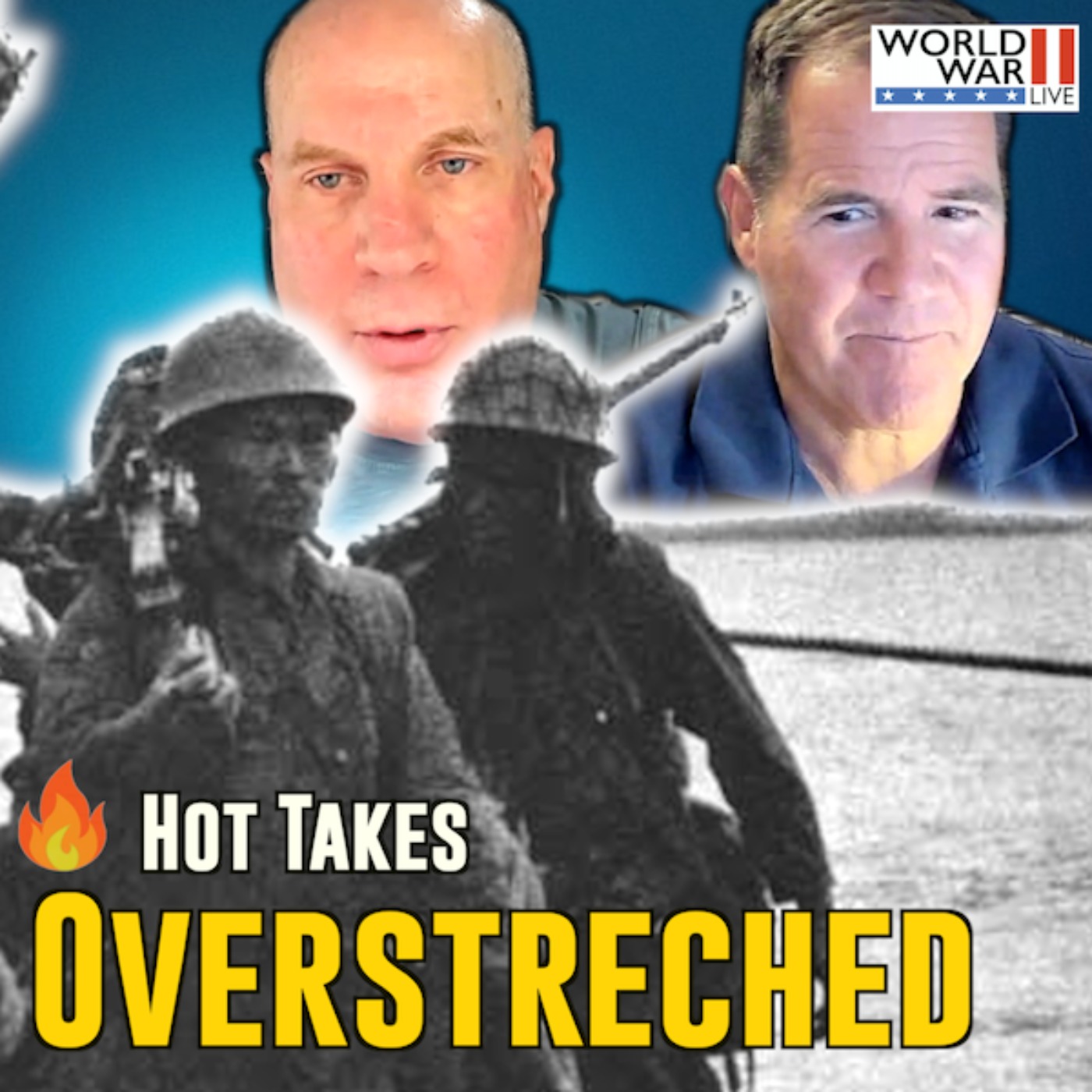
Guadalcanal Was Only Half the Story | WW2 Hot Takes
World War 2 LIVE · 1h06m · Jul 31
Dr. John C. McManus — professor of US military history, Missouri S&T
World War IIStrategy & Grand StrategyTactics & Battles
McManus argues that Guadalcanal and New Guinea were a single interconnected campaign from the Japanese perspective, and that studying them separately distorts our understanding of the Pacific War's turning point. He connects the Nimitz and MacArthur commands, showing how Japanese resource allocation between the two theatres shaped outcomes in both. At over an hour with a professor of US military history driving the analysis, this is the strategic complement to Holland's ground-level Guadalcanal episode — and pairs directly with Harris's Cactus Air Force instalment to give you the fullest picture of the mid-1942 Pacific War available in podcast form right now.
🏛 Where to see it: The Australian War Memorial in Canberra preserves primary sources and artefacts from the New Guinea campaign (1942–1945), including correspondence and operational records from MacArthur's Southwest Pacific Area command. The National WWII Museum in New Orleans holds extensive Guadalcanal campaign documentation and artefacts, including personal accounts from participants in both the naval and ground operations.
🎙 Veterans' accounts: Library of Congress Veterans History Project holds 100,000+ interviews including extensive Pacific War veteran testimony — searchable at loc.gov/vets
⚖ The debate: Should Guadalcanal and the New Guinea campaign be studied as a single integrated Japanese strategic problem, or as separate Allied operational theaters? McManus argues for integrated analysis of Japanese resource allocation across both fronts; traditional Pacific War historiography has often treated them as distinct campaigns under separate Allied commands (Nimitz vs. MacArthur).
🔴 Essential
Operation Barbarossa: One Man's War (Part 7)
We Have Ways of Making You Talk · 59:25 · Jul 29
James Holland & Al Murray
World War IIMemoir & Personal Account
Holland and Murray continue their Barbarossa series through the lens of Wilhelm Prüller's diary, examining how Nazi propaganda shaped the mindset of ordinary soldiers and what the troops themselves expected from the invasion of the USSR. The ideological dimension is foregrounded here — radicalisation, expectations of a quick victory — but it's grounded in the campaign's operational reality. A strong instalment in what's becoming one of We Have Ways' best long-form efforts.
📜 Read the source: Wilhelm Prüller's diary — used throughout the episode as the primary lens for examining soldier perspectives during Operation Barbarossa
Operation Barbarossa: The Surge (Part 6)
We Have Ways of Making You Talk · 51:48 · Jul 27
James Holland & Al Murray
World War IITactics & BattlesLogistics & Supply
The operational meat of the Barbarossa series: Panzer Group Guderian's advance to the Dnieper, the problem of outrunning your own logistics, and the Wehrmacht's treatment of Soviet partisans and POWs. Holland is particularly good on the paradox of 'suffering from success' — how rapid advances created vulnerabilities that would matter enormously by autumn. More campaign-focused than Part 7, and the stronger episode of the two this week.
The Cactus Air Force v. The Tokyo Express
The History of WWII Podcast · 27:18 · Jul 30
Ray Harris Jr. — independent historian covering WWII chronologically
World War IIAir WarfareNaval
Ray Harris Jr. covers the late August–early September 1942 struggle over Guadalcanal — the Japanese Tokyo Express reinforcement runs and the Cactus Air Force's attempts to interdict them. Short at 27 minutes but tightly focused on the operational cat-and-mouse that set the stage for the next major ground battle, and the Japanese logistical strain Harris documents here is exactly the kind of cross-theatre resource problem McManus frames on the strategic level. Harris's chronological approach means you get the day-by-day texture that broader accounts skip.
Alexander the Great's Mad Scientist
The Ancients · 1h12m · Jul 30
Prof. Edmund Richardson & Dr Tristan Hughes
AncientFortification & SiegeWeapons & Technology
Tristan Hughes and Professor Edmund Richardson tell the story of Diades, Alexander's military engineer, and his role in the siege of Tyre in 332 BC — the causeway construction, the fire ships, the molten sand, and the engineering ingenuity that made an 'impossible' siege work. At over an hour, this is properly detailed siege warfare with a focus on the technical and tactical problems of reducing an island fortress. One of the better Ancients episodes in recent memory for anyone interested in pre-gunpowder siege craft.
🌍 The Other Side: French scholarship reassesses Diades' engineering role
English-language scholarship typically credits Diades of Pella as Alexander's chief siege engineer at Tyre, following Vitruvius and Athenaeus Mechanicus. French classical scholarship has long questioned this attribution. Pierre Leriche (French archaeologist, specialist in Hellenistic fortification at CNRS) and other researchers in the French tradition of poliorcetics studies emphasise that the literary sources conflate multiple engineers and that the causeway and siege tower innovations at Tyre likely drew on a broader Macedonian and Phoenician engineering tradition rather than a single inventor-genius. This reframes Diades as a literary construct consolidating collective technical knowledge.
🟡 Selections
The Cuxhaven Raid
Lions Led By Donkeys · 1h00m · Jul 26
Peter Crean & Luke Robinson
World War INavalAir Warfare
Lions Led By Donkeys covers the Christmas Day 1914 Cuxhaven Raid — the Royal Navy's seaplane attack on German Zeppelin sheds, one of the earliest combined naval-air operations in history. A niche but genuinely interesting episode on the birth of carrier aviation.
🏛 Where to see it: The Imperial War Museum, London, holds official Royal Navy records and photographs documenting the Cuxhaven Raid of December 1914 and early naval aviation operations.
The Need For British Army Cold War Stay-Behind Patrols
The Unconventional Soldier · 30:18 · Jul 26
Colin Ferguson — British Army veteran (22 years' service)
Cold WarIntelligence & Espionage
A tribute to Major General Tony Stone, founder of 4/73 (Special OP) Battery — the British Army's long-range surveillance and target acquisition unit, created in 1982 for Cold War stay-behind operations. Ferguson draws on his own service experience to explain the unit's role and doctrine.
📅 Prompted by the recent death of Major General Tony Stone, the unit's founder.
The Blitz Beyond London
Dan Snow's History Hit · 42:31 · Jul 27
John Nichol — former RAF navigator and author of Blitz; Dan Snow
World War IIAir WarfareHome Front & Society
John Nichol — former RAF navigator and author of Blitz — joins Dan Snow to cover the Luftwaffe's bombing campaign against Britain's provincial cities: Newcastle's shipyards, Liverpool's docks, Glasgow, Cardiff. Strips back the 'Blitz spirit' narrative to examine the actual human and industrial cost of the air war outside London.
J. Robert Balch: M8 Greyhound Turret Gunner 94th Recon Squadron, France and Germany Ep 3 of 4
The Warrior Next Door · 30:34 · Jul 27
J. Robert Balch — WWII veteran, 94th Recon Squadron; Tony Lupo — Library of Congress veteran-history interviewer
World War IIMemoir & Personal AccountTactics & Battles
First-person veteran testimony from Robert Balch, turret gunner on an M8 Greyhound with the 94th Recon Squadron, 14th Armored Division — covering his baptism of fire at Gertwiller in November 1944, scouting missions against the Siegfried Line, and the physical toll of winter combat. Raw oral history with real tactical detail about armoured reconnaissance operations.
🏛 Where to see it: The Siegfried Line (Westwall) fortifications near Wissembourg, France, preserve in-situ Dragon's Teeth anti-tank obstacles and bunker complexes accessible to visitors along documented heritage trails.
📚 Reading List
Blitz: When World War Two Came Home — John Nichol
John Nichol joins Dan Snow to talk about the Blitz beyond London, and this is the book behind that conversation — a former RAF navigator's account of the bombing campaign as it hit Newcastle, Liverpool, Glasgow, Cardiff, and dozens of other cities most Blitz narratives overlook.
Via: The Blitz Beyond London, Dan Snow's History Hit
📖 AmazonFire and Fortitude: The US Army in the Pacific War, 1941-1943 — John C. McManus
Dr. McManus makes the case on WW2 Live that Guadalcanal and New Guinea were really one interconnected campaign from the Japanese perspective — this is his deep study of the US Army's Pacific War during exactly that period, covering both theatres and the command rivalries between Nimitz and MacArthur.
Via: Guadalcanal Was Only Half the Story, World War 2 LIVE
📖 AmazonDiary of a German Soldier — Wilhelm Prüller
The Barbarossa series on We Have Ways is using Wilhelm Prüller's wartime diary as a through-line to show how an ordinary young man was radicalised and what he thought as the Wehrmacht pushed into the USSR. This is that primary source — unfiltered, uncomfortable, and essential for understanding the mentality Holland and Murray are unpacking.
Via: Operation Barbarossa: One Man's War (Part 7), We Have Ways of Making You Talk
📖 AmazonAlexander the Great and His Engineers — Edmund Richardson
Professor Richardson joins The Ancients to tell the story of Diades, the military engineer behind Alexander's seemingly impossible siege of Tyre. If you want more on the men who turned Alexander's ambitions into physical reality — causeways, siege towers, the lot — this is your next stop.
Via: Alexander the Great's Mad Scientist, The Ancients
📖 AmazonGuadalcanal: The Definitive Account of the Landmark Battle — Richard B. Frank
Both WW2 Live and The History of WWII Podcast are covering Guadalcanal this week — the Cactus Air Force, the Tokyo Express, Henderson Field. Richard Frank's book remains the standard single-volume treatment of the campaign, and it gives proper weight to the naval and air dimensions that made the ground fight possible.
Via: Episode 642-The Cactus Air Force v. The Tokyo Express, The History of WWII Podcast
📖 Amazon
If a friend would find this useful, send them the link. That’s the entire growth strategy.